TCF Canada speaking: ask questions that get new information

You have two minutes to prepare: you want to join an evening activity and need to find out what matters. You ask when it starts. The other person answers, then adds that groups are organised by level. Do you build on that detail, or move to the next question on your list even though it no longer fits?
Perhaps you are learning French in evening classes in Pune or Lagos while your working day runs in English. Explaining a topic you know may already go well. Leading a conversation in which you ask is a different skill, and memorised questions do not solve it. A useful question depends on what is still missing, so it can change after every answer.
Today you rehearse one short situation and add a follow-up after the reply. Then you check one thing: which of your questions, tied to the situation, asked for different information? We do not turn that into a TCF score, an NCLC level or Express Entry points.
What the speaking part asks of you
France Éducation international's TCF Canada page describes the speaking part as a one-to-one test with an examiner: three tasks in 12 minutes, 2 of which are for preparation. Task 2 is an interaction with preparation, 5 minutes 30 in all, in which you obtain information in an everyday situation. The instructions say who you are and who the other person is.
The official speaking sample adds two details: in this task you speak first and lead the conversation, and you may ask for more detail or a repetition. The examiner waits for your questions.
This practice is independent. It is not the official exam and is not affiliated with France Éducation international or IRCC. The situations below are original; for your session's rules, rely on the official pages and your test centre.
Keep the immigration file separate from the speaking task
IRCC lists TCF Canada among the approved language tests for Express Entry, and results must be less than two years old both when you complete your profile and when you apply for permanent residence. The CRS criteria include additional points for French skills, and the French-language proficiency category asks for a minimum of NCLC 7 in all four abilities. Speaking is one of the four, so it weighs as much as the others.
Those rules decide your file. Choosing Express Entry in the questionnaire only changes the situation's context; it does not check eligibility or estimate NCLC, CLB or CRS points.
A short exchange to get information
This example is made up: you want to join a French conversation evening at a public library.
| French | Meaning in English |
|---|---|
| Bonsoir, la soirée de conversation commence à quelle heure ? | Good evening, what time does the conversation evening start? |
| À dix-neuf heures. On travaille en petits groupes selon le niveau. | At seven. We work in small groups by level. |
| Comment est-ce qu'on choisit son groupe ? | How do you choose your group? |
| On discute un peu avec l'animatrice en arrivant. | You have a short chat with the host when you arrive. |
| Est-ce qu'il faut s'inscrire avant de venir ? | Do you need to sign up before coming? |
The reply to the first question brings a new fact, groups by level, and the second question builds on it. The third asks about something not yet covered: signing up. Do not memorise this order. If the host had already mentioned signing up, asking again would add nothing; look for another gap, such as the cost. Let what you hear choose your next question.
Now change one detail
Move the evening online. What do you need to know now? Perhaps how to join, or whether you need a camera. Stop asking about the room, which is no longer part of the situation.
Then try the reverse: the time is clear, but signing up is not. Ask one question, listen, and only then add a second. If it repeats what you already know, name what is still missing first.
What you can check in your recording
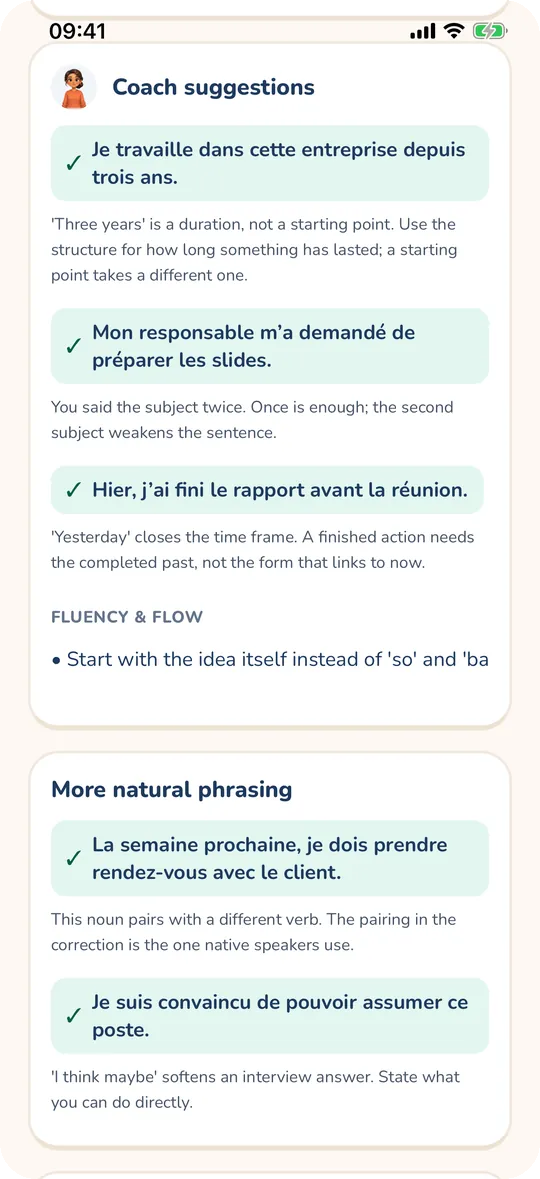
The open observation shows your questions tied to the situation that ask for different information, as the transcript heard them. A question repeated because the audio cut out is not a language error, but it adds no information either.
This is not a number to push up: two well-placed questions teach more than a long list asked without listening. It says nothing about your exam result. If the transcript is not reliable, you are asked to record again.
The full report then goes task by task: which tasks your answers covered and which they missed, where you paused, and a stronger version of each answer that adds no new facts.
From a memorised list to a real follow-up
Pick one question from your recording and name the information it asked for. Was that information already in the reply before it? If so, you need a new question, not a smoother version of the old one. Next time, use a different activity, such as a weekend sports club, to see whether your way of asking transfers.
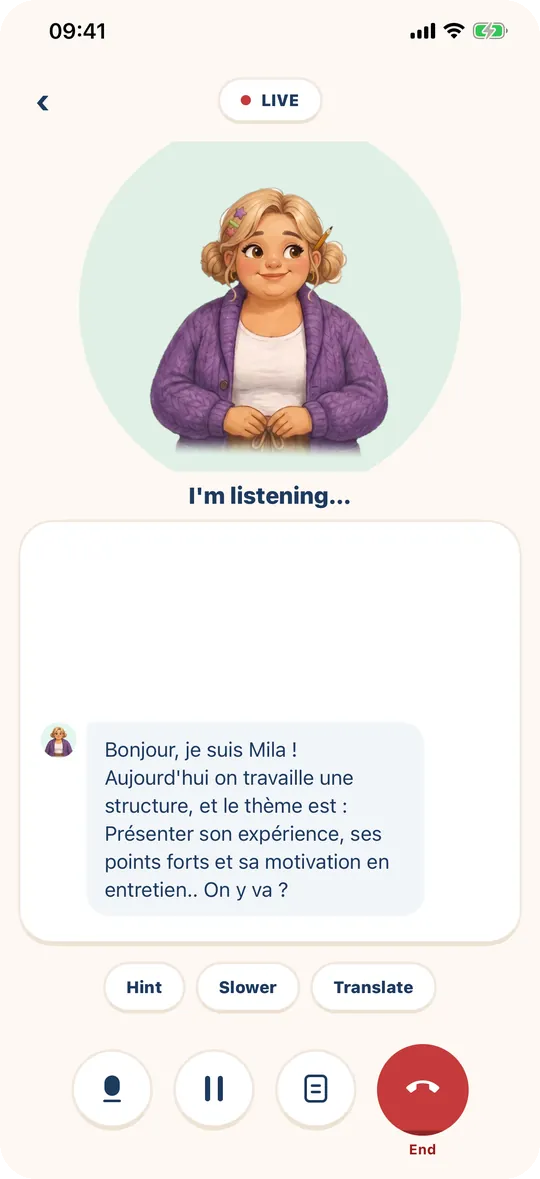
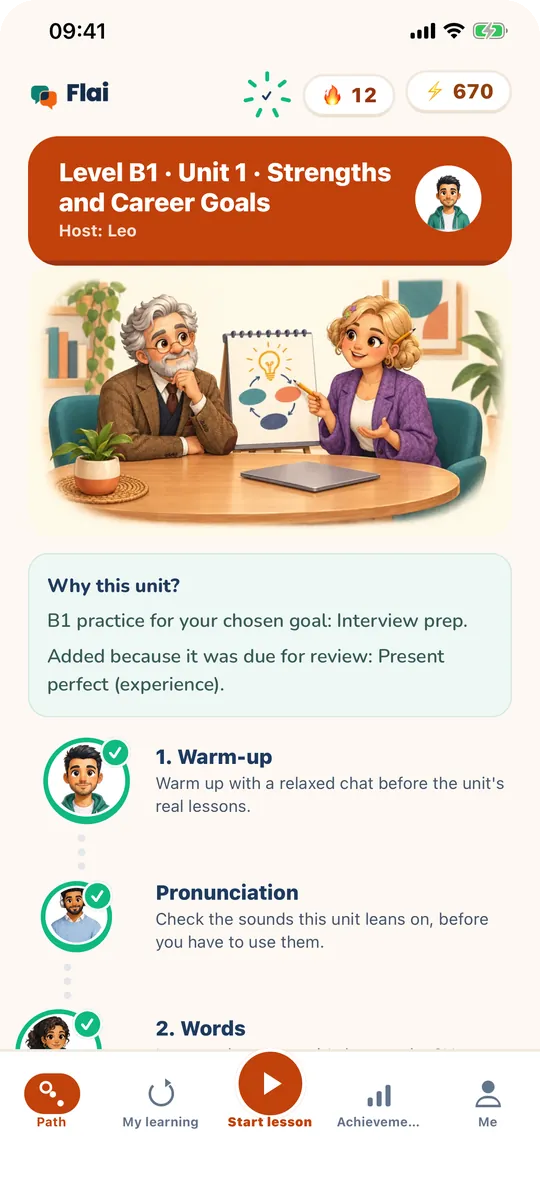
The Flai app offers live voice lessons with an AI coach, an analysed report after every lesson, a personal curriculum path, French pronunciation drills and review exercises. It has no TCF module, and this situation does not open automatically in your next lesson.
A short checklist
- I know my role and the information I am missing.
- I did not ask about a detail the instructions already gave.
- I listened to the reply before choosing my follow-up.
- I can tell a request to repeat apart from a question that asks for something new.
- I did not read the result as an exam score or an immigration outcome.
Questions
Does the report give me an NCLC or CLB level?
No. It does not convert your answers into an official result or immigration points.
Is this as long as the real task 2?
No. The official task lasts 5 minutes 30, with 2 minutes of preparation, face to face with an examiner. Here you record short answers, and the reply you build on is a fixed written line.
If my speaking result is low, can I ask for a re-mark?
France Éducation international says re-marking of the speaking and writing parts is suspended for sessions from 1 September 2026, with the service expected back in autumn 2027. You can sit TCF Canada as often as you like, with 20 days between sittings.
How do I see the report?
Once you enter your email, the full report opens on screen right away. Continuing with Pro in the app is paid.
Sources
Checked on 4 October 2026: the France Éducation international pages linked above and IRCC's Express Entry pages on language tests, CRS criteria and category-based selection. The examples and the practice were written independently.
Sources
- France Éducation international: TCF Canada
- France Éducation international: TCF TP, TCF Canada, TCF Québec, sample speaking tasks
- IRCC: Language test results for Express Entry
- IRCC: Comprehensive Ranking System criteria
- IRCC: Express Entry category-based selection
Checked on October 4, 2026. Exam rules change; always confirm with the official source.