Goethe A1 speaking: turn a word card into a real question

The examiner hands you a card. At the top it says “Thema: Freizeit”, and in the middle there is one word: “Kino”. You know the word. What you cannot find, in that second, is a question for the person next to you. The introduction you rehearsed for weeks has your name, city and job in it, but not a single question.
That is the narrow problem here. When you prepare between marriage paperwork and a visa appointment, it is natural to polish one long answer. The A1 speaking part asks for three kinds of sentence, though: information about you, a question that gets information from someone else, and a request. A memorised paragraph covers only the first.
Today you will build a short introduction, turn one word into a question and make one polite request. A made-up profile is fine. After you record, the observation is deliberately narrow: which of the asked-for introduction details did you actually say?
What happens in the speaking part
The Goethe-Institut's exam page sums it up: you introduce yourself to the group, ask and answer questions on everyday matters, and ask someone in the group for something, in 15 minutes. The Terms and Conditions for Exam Administration, in force since 1 September 2025, add the frame: up to four candidates, two examiners, no preparation time, and each part shown with an example first.
The official Modellsatz shows the three parts. Part 1: introduce yourself from keywords, then spell a word and say a number. Part 2: draw a card with a topic and a word, ask another candidate a question and answer theirs. Part 3: draw picture cards of everyday objects, make a request and respond to one.
This rehearsal is not the official Goethe exam and is not affiliated with the Goethe-Institut. Its questions and examples were written for this page, and it does not recreate the group exam or its marking.
Keep the visa question separate
If you apply from India, the German Missions in India ask many spouse visa applicants for a recognised German certificate at least at level A1, from an exam taken no more than a year earlier, and name Goethe-Institut “Start Deutsch 1” among the examples. They also say it is not always needed: it is mandatory for almost everyone marrying a German citizen and for most spouses of residents who are not in Germany on a skilled-work permit. From Pakistan or elsewhere, the Federal Foreign Office points you to the German mission in your country.
This page does not decide what your application needs, and the rehearsal says nothing about a visa outcome.
What the other person wants to find out
In the introduction, the listener wants clear facts about you in the simplest form. If the keyword is “Wohnort”, give a place: “Ich wohne in Pune.” Treat each keyword as its own slot, so you can carry on if you lose your place.
With the word card, you are the one asking. Saying only “Kino?” leaves your partner guessing. Decide first, in English, what you want to know: whether they like the cinema, or when they last went. Then build the German question with the words you have.
A request is a different act again. Asking someone to close the window is not asking where the window is. Before you speak, ask yourself: do I want information, or do I want the other person to do or give something?
A short exchange
An invented exchange in a language class, not an official exam card.
| German | Meaning |
|---|---|
| Ich heiße Arjun. Ich wohne in Pune. In meiner Freizeit spiele ich Cricket. | My name is Arjun. I live in Pune. In my free time I play cricket. |
| Gehen Sie gern ins Kino? | Do you like going to the cinema? |
| Ja, sehr gern. Am Wochenende. | Yes, very much. At the weekend. |
| Können Sie bitte das Fenster schließen? | Could you close the window, please? |
| Ja, natürlich. | Yes, of course. |
The first line gives information, the second asks for it, the fourth asks for an action. Read them one at a time, then hide the table and speak from three notes: “me”, “Kino”, “window”.
If a sentence will not come, use another form you know with the same meaning: “Machen Sie bitte das Fenster zu.” works as well. What to avoid is naming the object without asking for anything.
Now change one detail
Change the city and the hobby in your introduction. Keep to the three things the exercise asks for, without your date of birth or full address. Then swap the card: “Kino” becomes “Bahnhof”. Do you want to know where the station is, or when the next train leaves? Pick one and ask.
For the request, keep the window but ask for it to be opened, not closed. With each change, work only on the task that changed rather than replaying the whole conversation.
What to look for in your recording
The first open observation is coverage of your introduction. This rehearsal asks for your name, where you live and one hobby, and shows which of those the transcript contains. It is not the official exam's list of required details or its marking scheme.
Speech recognition can misspell names, so “Arjun” or your town may come out wrong. Do not read anything about your German into that; listen to the recording and check whether the detail was said. If the audio is not usable, you are asked to record again rather than shown a guessed list of gaps.
One task per round
Once your introduction covers what was asked, spend the next attempt on the question, then one on the request. Do not try to fix grammar and pronunciation everywhere at once. The rehearsal leaves out spelling, so practise the German letter names of your passport spelling separately.
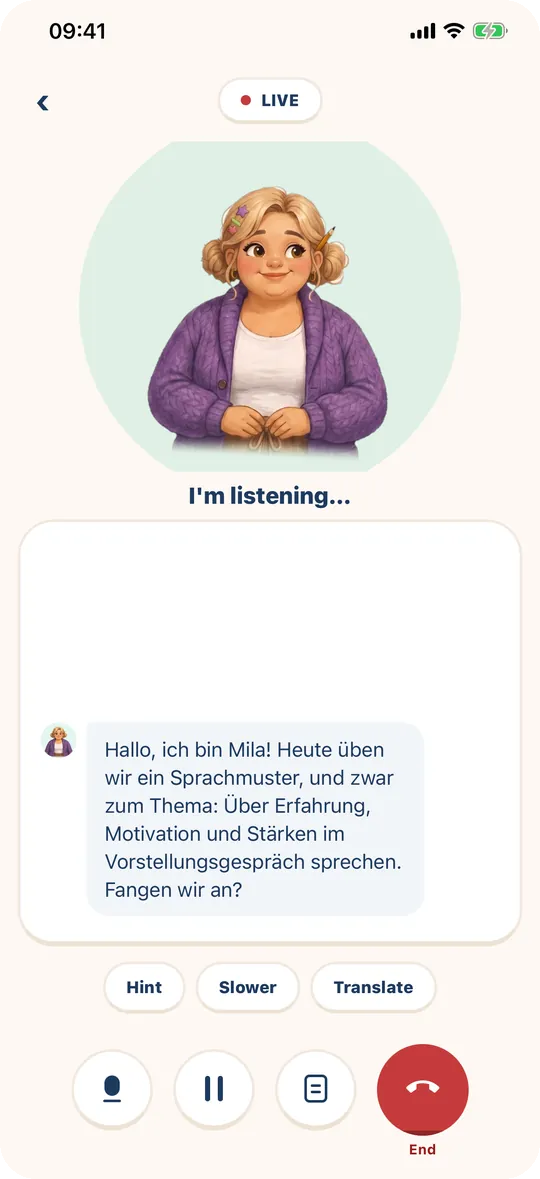
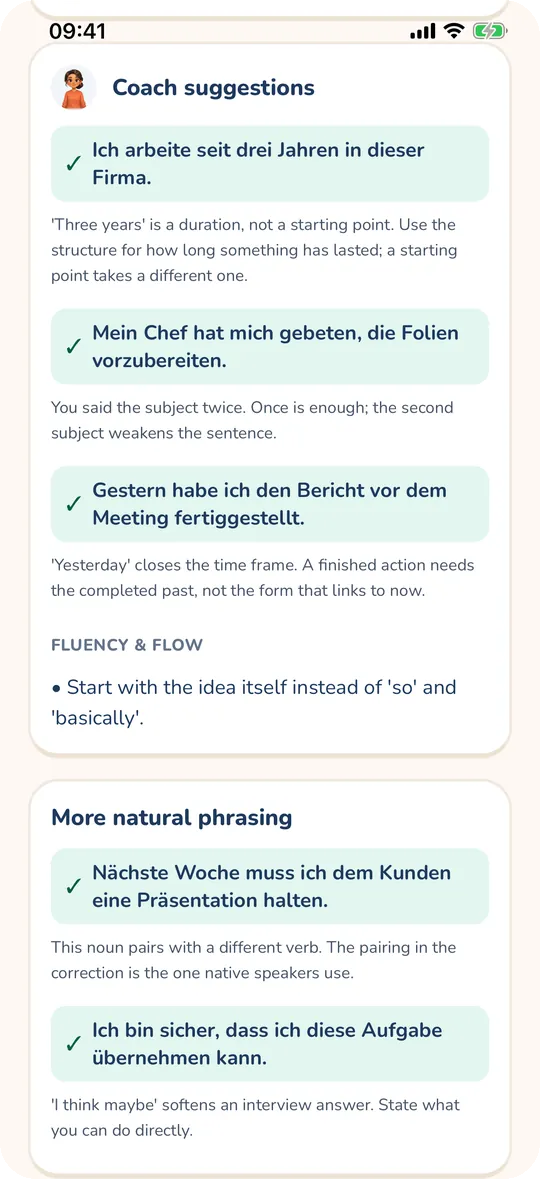
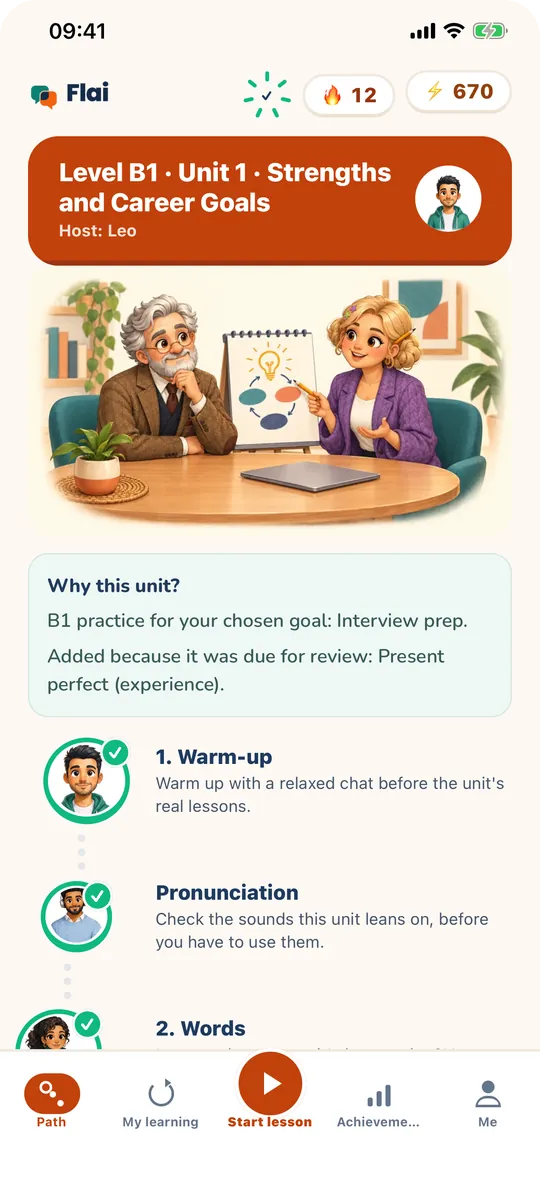
The Flai app has live voice lessons with an AI coach, an analyzed report after every lesson, a personal curriculum path, German pronunciation drills and review exercises, for general German practice. There is no Goethe A1 module, and these cards do not open there automatically.
Quick checklist
- I can tell whether a task asks me to introduce, ask or request.
- My introduction contains the details the instruction asked for.
- My question asks for the information I chose before speaking.
- My request names the action I want from the other person.
- I said each sentence again with the model hidden.
FAQ
Will this rehearsal tell me whether I am ready for the exam?
No. It shows which details appeared in one task and gives notes on three short answers. It leaves out spelling, numbers, the group format and the written parts, and it does not estimate whether you would pass.
Does a Goethe A1 certificate guarantee the spouse visa?
No. The mission's document list includes far more than a language certificate, and the decision rests with the authorities, not with an exam result.
How do I see the report?
Once you enter your email, the full report opens on screen right away. Continuing with Pro in the app is paid. No result is made up if the recording cannot be analysed.
Sources
Exam format checked on 4 October 2026 in the Goethe-Institut's exam page, Modellsatz and Terms and Conditions; visa context from the German Missions in India and the Federal Foreign Office, the same day. The examples are original.
Sources
- Goethe-Institut: Goethe-Zertifikat A1, further information
- Goethe-Institut: Start Deutsch 1 Modellsatz
- Goethe-Institut: Start Deutsch 1 Terms and Conditions for Exam Administration (1 September 2025)
- German Missions in India: Joining a spouse or partner of a civil partnership
- Federal Foreign Office: German language skills for foreign spouses
Checked on October 4, 2026. Exam rules change; always confirm with the official source.