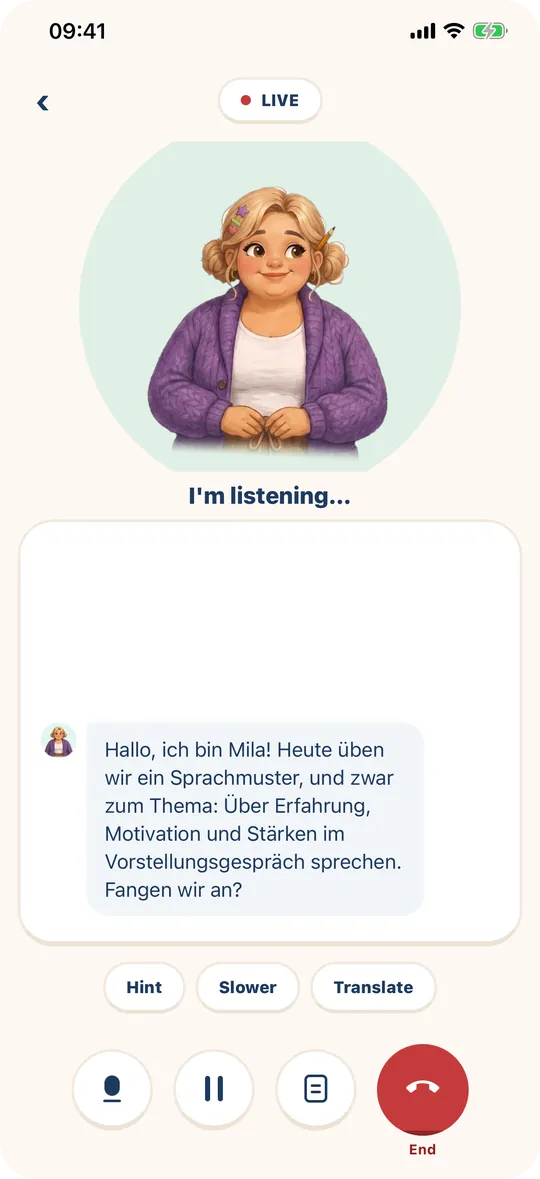
DTZ speaking: your partner says no. What do you suggest instead?

Your integration course is nearly over, and in a practice round you and a classmate are planning a small party for the last day. You suggest Friday evening. Your partner answers: “Am Freitagabend kann ich nicht. Da arbeite ich.” Your prepared sentences are used up. If all that comes out is “Ah, okay”, this one moment is what to practise, not the whole conversation.
In a planning conversation, getting through your own list of ideas is not enough. What your partner just said changes the plan. Suggesting Friday again in nicer words moves nothing forward. A short new option, plus the reason it works, gives your partner something to answer.
Today you work on that switch with two short tasks. First you suggest a plan, then the situation changes and you respond to it. In your recording we look at one concrete thing: did you give a reason for your alternative? How long you spoke, or how your accent sounds, is not what this exercise is about.
What the DTZ planning part asks of you
The Deutsch-Test für Zuwanderer is the final language test of the integration course. g.a.s.t. has run it since January 2023 on behalf of the Federal Office for Migration and Refugees (BAMF), and it tests German at A2 and B1. BAMF describes the oral part as briefly introducing yourself and talking with the examiners and another candidate about set topics.
The g.a.s.t. practice set shows the oral exam as a pair exam in three parts. The last part is “Gemeinsam etwas planen”: both candidates get the same sheet with a situation and a few notes, share ideas, make suggestions and react to each other's suggestions. The examiner steps in only if the planning conversation needs support.
This page covers that reaction only, not the self-introduction or the photo part. Flai's rehearsal is not the official exam and is not affiliated with g.a.s.t. or BAMF. Its dialogues and questions are original, and it gives no exam score or pass prediction.
What your partner needs to hear
When your partner turns down an idea, they first need your new option, then how it fits the plan. “Then Saturday afternoon, most people are free then” contains both. The reason does not have to be clever or personal; it only has to connect to the option you are offering.
Think of three small steps: I heard the problem, I have a new option, there is a reason for it. They do not have to be three sentences. Start with whatever form you can produce now, and combine sentences later if the meaning stays the same.
A short example
Imagine two classmates planning a small party for the end of their course. Names and details are only for practice.
| German | Meaning |
|---|---|
| Wollen wir den Kursabschluss am Freitagabend feiern? | Shall we celebrate the end of the course on Friday evening? |
| Freitagabend kann ich nicht. Da arbeite ich. | I can't on Friday evening. I'm working. |
| Dann vielleicht am Samstagnachmittag? Da haben die meisten frei. | Then maybe Saturday afternoon? Most people are off then. |
| Gut. Und wo? Im Kursraum? | Good. And where? In the classroom? |
| Lieber im Park. Da können auch die Kinder mitkommen. | Better in the park. The children can come along there too. |
“Da haben die meisten frei” carries the reason for the new day. It is short, but the choice no longer hangs in the air. Then the topic moves from the day to the place, and the park comes with its own reason.
Read the dialogue once. Then cover the third and fifth lines and answer from your partner's lines only. If “Dann vielleicht” does not come, “Wie wäre es mit Samstag?” or a plain “Samstag geht. Da habe ich frei.” works too. The goal is a suitable alternative, not one fixed pattern.
Now change one detail
Now Saturday does not work for your partner either: “Am Samstag habe ich einen Termin.” Choose a new day and a reason it suits the group; it does not have to be your real timetable. Write two keywords first, then say them as German sentences.
In the second round, keep the day but change the place: rain is forecast, so the park is out. Where else could you meet? Tie your reason to the place this time, instead of adding “Da habe ich frei” to every answer.
What to look for in your recording
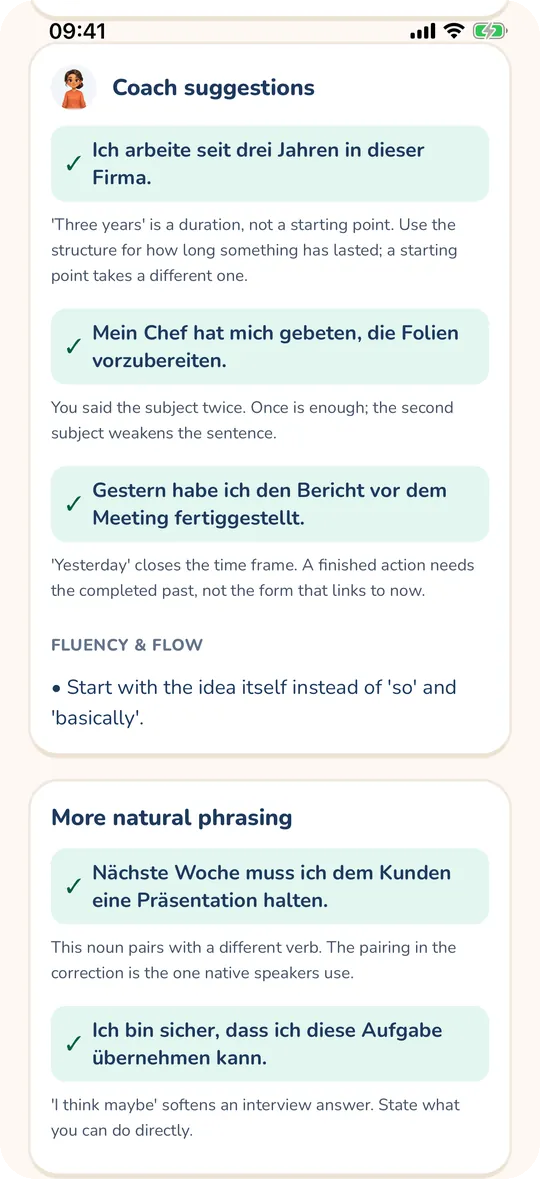
The visible finding is whether your answer to the changed situation contains a reason. Where the system can show this, it marks the phrase in the transcript. Counting “weil” or “denn” is not enough: a separate sentence such as “Da haben die meisten frei” can be a reason too. What matters is the link in meaning.
Do not treat every gap in the transcript as your mistake; the microphone may have missed a word. Listen to the marked passage and record again if the audio is unreliable. This check says nothing about your overall German level or your other exam answers.
After you have added the reason
The short rehearsal behind the card uses a different scene: you plan a cooking evening with your study group, and then the room is not free on your day. Next time, change the topic again, for example to a museum visit, and respond to the new condition instead of reusing the same sentence. If you stop mid-recording, try continuing from where you are rather than starting over.
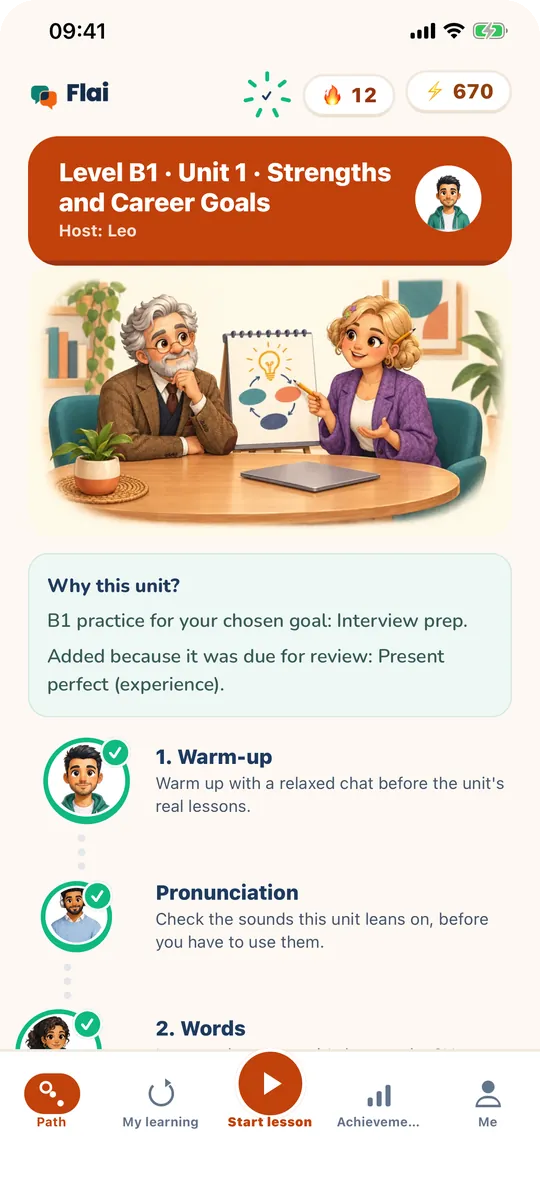
The live voice lessons with Flai's AI coach and the analyzed report after each lesson can be used for general speaking practice, along with a personal curriculum path, German pronunciation drills and review exercises. There is no DTZ module in the app, and this scene does not open there automatically.
Quick checklist
- I checked that my exam really is the DTZ and not another B1 exam.
- I did not suggest the option my partner had just ruled out.
- My new option answers the actual problem: the time, the place or something else.
- I gave one reason that fits this option.
- I left room for my partner to respond, for example with “Passt dir das?”
- I listened to unclear passages before counting them as mistakes.
Frequently asked questions
Do I have to disagree with my partner to show my German?
No. The g.a.s.t. task description includes making suggestions and reacting to your partner's suggestions, and accepting a good idea is a reaction. Disagree when the plan really needs it, not to fill time.
What if I don't understand my partner's objection?
Ask before you answer. “Wie meinst du das?” or “Kannst du das bitte wiederholen?” keeps the conversation going, and a counter-offer built on a misunderstanding solves the wrong problem.
Will these two tasks tell me whether I will reach B1?
No. They give you one example of responding to a changed plan. The DTZ result comes from the whole exam as rated by the examiners. The rehearsal produces no level, band or pass prediction for it.
How do I see the report?
Once you enter your email, the full report opens on screen right away. Continuing with Pro in the app is paid. If the recording cannot show a skill, no score is invented for it.
Sources
Checked on 4 October 2026: the g.a.s.t. DTZ page, the g.a.s.t. practice set 1 (June 2024 edition) and the BAMF page on the final examination. The examples here were not copied from these sources.
Sources
- g.a.s.t.: Deutsch-Test für Zuwanderer
- g.a.s.t.: DTZ Übungssatz 1 (June 2024)
- BAMF: The final examination
Checked on October 4, 2026. Exam rules change; always confirm with the official source.