Dutch NT2 speaking exam: add the reason the question asks for

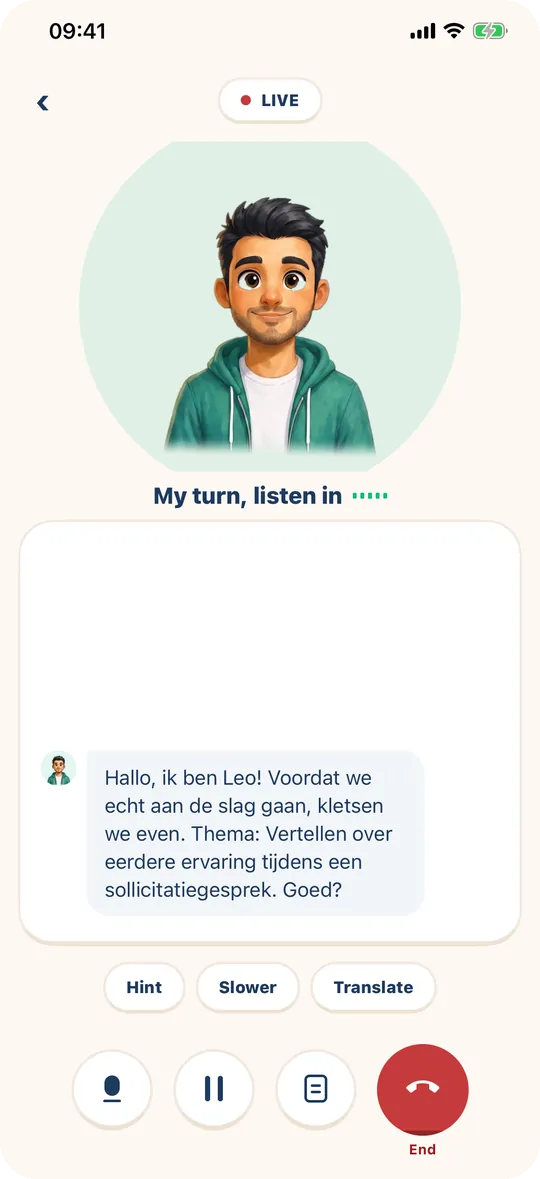
You are practising at the kitchen table after work, headphones on. A voice asks why the Thursday training suits you better than the Monday one. You say “Ik kies donderdag” and stop. The recording keeps running. You gave your choice, but the question asked for the reason.
At work in English you would add the why without thinking. In Dutch, with a timer running, it is easy to say the first half and stall between “omdat” and “want”. What is missing is not your whole Dutch, just one piece of information the question asked for.
Today you will answer a short question, add the missing detail, then change one thing about the situation. Afterwards you will check your recording for a single point: is the reason actually there? The situation can be entirely invented, and you do not need to share any documents.
Which speaking exam are you preparing for?
The Staatsexamen Nt2 has two programmes: Programma I at B1 and Programma II at B2, according to the exam board's English page. People take it for work, study or civic integration.
The speaking exam runs on a computer. Staatsexamens Nt2 describes it like this: you wear headphones, hear each task and read it on screen, and speak into a microphone to the computer, not to a person. One beep tells you to start, another tells you time is up, and you cannot go back to an earlier task. Programma I has 8 short tasks with 20 seconds of speaking time each and 8 medium tasks with 30 seconds each. Programma II has 4 short tasks, 8 medium tasks and one long task of two minutes with preparation time.
If you have a civic integration obligation, DUO says to check Mijn Inburgering for the exams you need. Its A2 speaking exam is also on a computer: you watch short films and answer questions.
Flai's short rehearsal is not an official exam and is not affiliated with DUO or Staatsexamens Nt2. Its three tasks are original and do not copy the number, order or timing of the real tasks.
What does the question want to hear?
Staatsexamens Nt2 describes the medium tasks as questions that need a longer answer, a few sentences or more. When a task starts with “Waarom”, the centre of your answer is the reason, not the choice. Repeating the question adds nothing new.
Catch the question word before you start: “Welke” asks for a choice, “Waarom” for a reason, “Wat stelt u voor?” for a proposal. For the link, you have two correct options. “Want” keeps normal word order: “want op maandag heb ik overleg”. “Omdat” sends the verb to the end: “omdat ik op maandag overleg heb”. Under time pressure, “want” may feel easier.
Do not bolt a reason onto every answer, though. If a question only asks which day, say the day.
A short exchange in Dutch
This is an invented conversation about a training at work.
| Dutch | Meaning |
|---|---|
| De training is op maandagochtend of op donderdagmiddag. Welke kiest u? | The training is on Monday morning or Thursday afternoon. Which do you choose? |
| Ik kies donderdagmiddag. | I choose Thursday afternoon. |
| Waarom past donderdag beter? | Why does Thursday suit you better? |
| Op maandagochtend heb ik altijd overleg met mijn team. Donderdagmiddag is rustiger. | On Monday mornings I always have a meeting with my team. Thursday afternoon is quieter. |
| De training op donderdag gaat niet door. Wat stelt u voor? | The Thursday training is cancelled. What do you suggest? |
| Dan volg ik de training online, want dan hoef ik niet te reizen. | Then I will follow the training online, because then I do not have to travel. |
“Ik kies donderdagmiddag” fully answers “Welke kiest u?”. The answer to “Waarom” gives a reason without “omdat”, and the last answer uses “want”. In a real task, choice and reason may sit in one question; splitting them here lets you hear each piece.
Now change one detail
Swap the training for a Dutch conversation group at the library, on Wednesday evening or Saturday morning. Choose one and give your reason with “want”, then say it again with “omdat”. Next, imagine the group on your day is full and suggest an alternative, with a reason.
Record two versions. In the first, take up to 30 seconds for choice, reason and alternative, with notes if you like. In the second, put the notes away and fit the choice and the reason into 20 seconds. If you cannot point to the reason on playback, do not delete everything: add the missing sentence and say it again.
What to listen for in your recording
The open finding is narrow: does your answer to the reason task contain a reason? If it does, the result quotes that part of the transcript. “Omdat” alone proves nothing. “Omdat… eh” with nothing after it is not a reason, while “Overdag werk ik” is one, even without a linking word.
Speech-to-text can get a word wrong, for example by hearing a Dutch word as an English one. If the transcript shows no reason, play that part of the recording before you accept the result. If the audio cut off or the answer was very short, record again; nothing is concluded from an unclear recording. And a reason in one answer does not predict your exam result.
Picking your next round
If the reason was there, change the topic next time, so you know you can build the answer again rather than remember this one. If not, repeat the same question with shorter sentences.
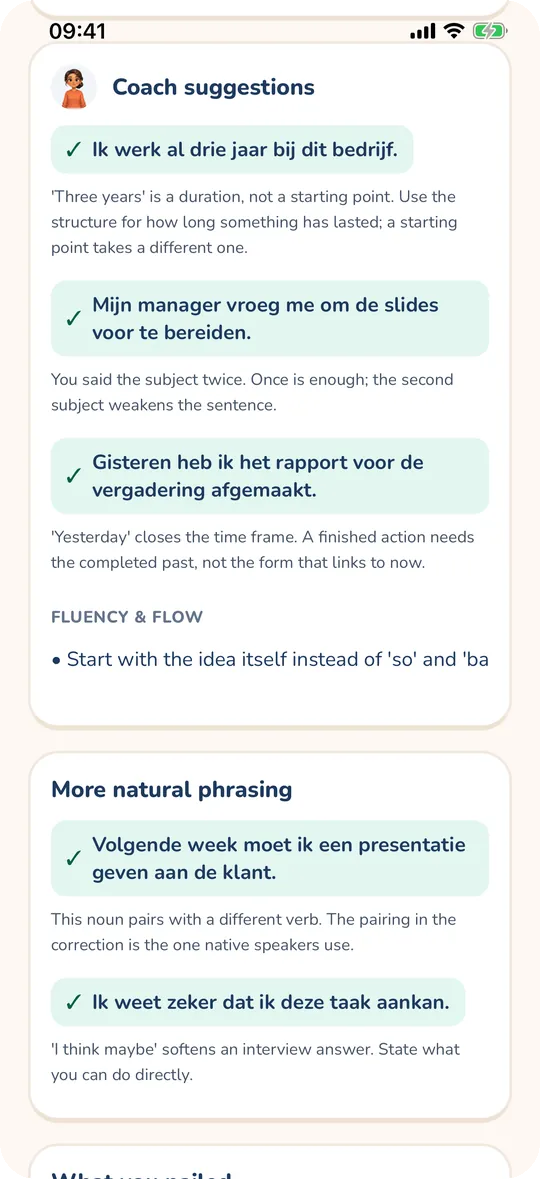
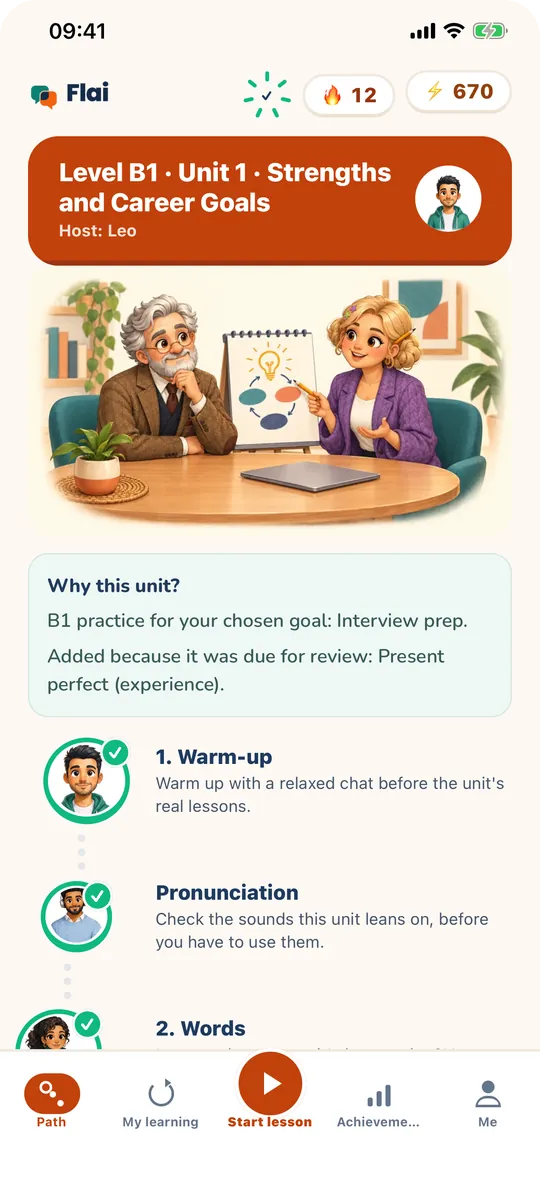
The Flai app offers live voice lessons with an AI coach, an analysed report after every lesson, a personal learning path, Dutch pronunciation drills and review exercises, for general Dutch speaking practice. There is no NT2 module in the app, and this rehearsal does not open automatically as a lesson.
Checklist before you record
- I know whether my registration says Programma I, Programma II or the A2 inburgering exam.
- I caught the question word (waarom, welke, wat stelt u voor) before speaking.
- My first sentence answers the question as it was asked.
- The reason fits my choice, even in an invented situation.
- I tried “want” when “omdat” slowed me down.
- I checked any doubtful transcript line against the audio.
FAQ
I came as a knowledge migrant, or as the partner of one. Do I need this exam?
This rehearsal cannot tell you. DUO tells people with a civic integration obligation to check Mijn Inburgering, and the exam board notes that schools and universities set their own language requirements. If you want NT2 for work, ask your employer which level they expect.
Should I take Programma I or Programma II?
The exam board recommends Programma I (B1) for study or work at vocational (mbo) level, and Programma II (B2) for work in Dutch-speaking companies or study at a university or university of applied sciences. In the rehearsal, picking I, II or A2 changes how demanding the Dutch is; it does not choose your route.
How do I see the report?
Once you enter your email, the full report opens on screen right away. Continuing with Pro in the app is paid.
Sources
The exam programmes and the speaking format were checked on Staatsexamens Nt2, its English page and DUO's page on the language exams on 4 October 2026. The example dialogue and practice steps were written for Flai.
Sources
- Staatsexamens Nt2: Hoe ziet het examen eruit?
- Staatsexamens Nt2: English
- DUO: Content of the language exams A2, B1 and B2
Checked on October 4, 2026. Exam rules change; always confirm with the official source.