Italian B1 for citizenship: give a reason for your choice in the oral

It is late evening in Ohio, or a wet Tuesday in Leeds, and you are going through your Italian after work. The opening is fine: your name, where you live, what you do. Then a practice question asks you to choose between two options. You pick one straight away. When you need to say why, you reach for a memorised phrase that does not quite fit, and the sentence stalls.
That is today's problem, kept deliberately small: connecting a choice to a reason the listener can follow. You do not need a speech or advanced vocabulary. You need the decision and the reason to arrive together in plain Italian, and to be able to adjust both when the situation changes.
You will rehearse an everyday choice, add a reason, then react to a change of plan. When you listen back, look for one thing only: the sentence that explains your decision. The examples are original and do not reproduce questions from any official exam.
First, pin down your route and your certificate
Italian law sets the language bar at no lower than B1 for citizenship granted to the spouse of an Italian citizen, and for grants under article 9, which are mostly tied to legal residence in Italy (Law 91/1992, art. 9.1). Some applicants are spared from presenting a certificate, so check where you stand. The Italian Ministry of Foreign Affairs lists the recognised certifying bodies: CILS, CELI, Cert.It, Ce.Co.L. and PLIDA. If your application follows another route, confirm what applies to you before booking anything.
The speaking part is not the same everywhere:
- CILS B1 Cittadinanza: its syllabus describes a dialogue with the examiner, preceded by a short personal introduction, about ten minutes in all.
- CELI 2 i (B1) cittadinanza: the exam description lists five parts: introducing yourself, describing pictures, an intercultural comparison, short explanations on civic topics and a role play.
- PLIDA B1: the Parlare paper covers an introduction, an interaction and a monologue, in about fifteen minutes.
This rehearsal works on one moment that appears in different shapes across those exams: choosing, saying why, and adapting when something new comes up. The CILS syllabus expects candidates to adjust how they express themselves when the other speaker introduces new elements.
This is an independent practice tool. It is not an official exam and is not affiliated with the Università per Stranieri di Siena, the Università per Stranieri di Perugia or the Società Dante Alighieri. The questions and timings belong to the exercise.
What does the listener need to hear?
Two things that belong together: which option you took, and what explains it. Offered an Italian class online or in person, you might answer “in presenza”. The decision is clear. The reason is still in your head.
One concrete reason is plenty: your working hours, the commute, the people you want to talk to. “Scelgo in presenza, perché così parlo di più” already gives the other person somewhere to go. They might ask about your week, or offer a different option.
A short exchange in Italian
The situation is invented. The examiner uses the formal “Lei”; if you are addressed with “tu”, follow that.
| Italian | Meaning |
|---|---|
| Il corso di italiano del comune è online oppure in presenza. Che cosa sceglie? | The town's Italian class is online or in person. Which do you choose? |
| Scelgo in presenza, perché così parlo di più con le altre persone. | I choose in person, because that way I talk more with the other people. |
| Il corso in presenza è a quaranta minuti da casa sua. Cambia qualcosa? | The in-person class is forty minutes from your home. Does that change anything? |
| Sì. Faccio il corso online durante la settimana e vado in presenza il sabato, quando ho più tempo. | Yes. I'll do the online class during the week and go in person on Saturdays, when I have more time. |
The last answer deals with the new fact, the distance. Repeating “scelgo in presenza” would ignore it. Notice that the reason changed too: it no longer explains a preference, it explains how you will make the plan work.
Now change one detail
Replace the class with a volunteer shift at a local food bank, a “banco alimentare”, on Saturday morning or Wednesday evening. Choose one and say why. Then imagine your shift is already full. What do you do instead, and why? One decision, one reason.
Record a first attempt with single-word notes, such as “sabato”, “sera” or “turno”. Then put the notes away and change the day. If a word escapes you, describe the idea in simpler words: “il posto dove danno il cibo” does the job when “banco alimentare” will not come.
What to listen for in your recording
Go back to the answer where you chose. Can you point to the sentence that gives the reason? “Perché” helps, but it is not enough on its own: what follows has to connect to the decision. “Scelgo il sabato. Quel giorno non lavoro” gives a clear reason without that word.
The open result of the rehearsal looks for exactly that link in your answer to the choice question, and shows the passage it used as evidence. A shaky transcript, a misheard name or a clipped recording does not prove you could not answer. In those cases, record again.
It is not a score or a forecast either: one clear reason in one answer does not stand for everything a B1 exam assesses. For your next attempt, pick a single adjustment.
Checklist for this attempt
- I checked the exact certificate name on my booking, not just “B1”.
- I said my choice before anything else.
- I gave one reason, not a list.
- After the change, my answer mentions the new fact.
- I listened to the quoted passage before accepting the transcript.
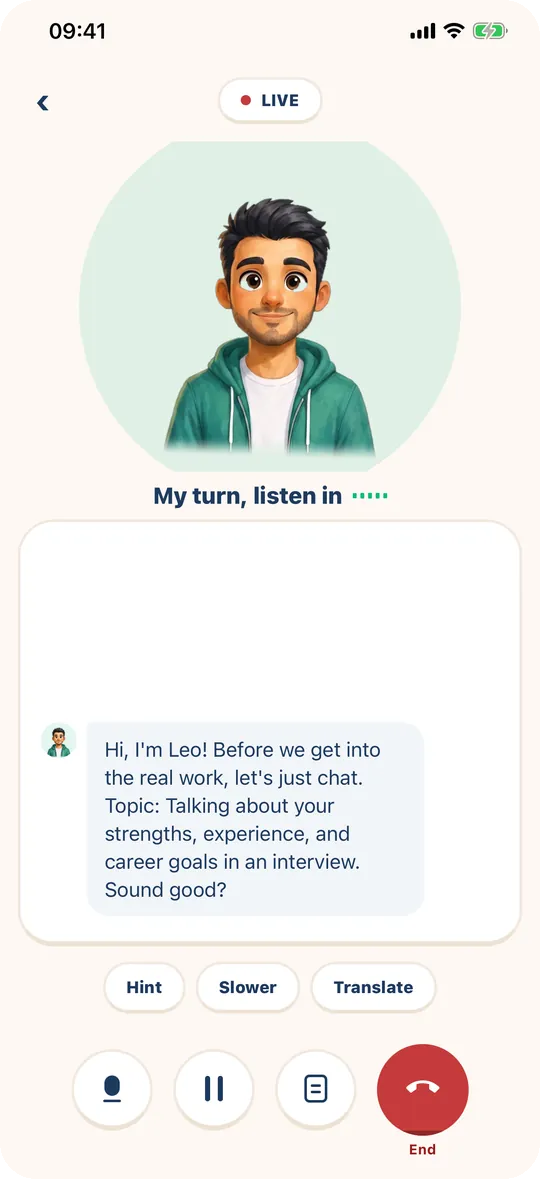
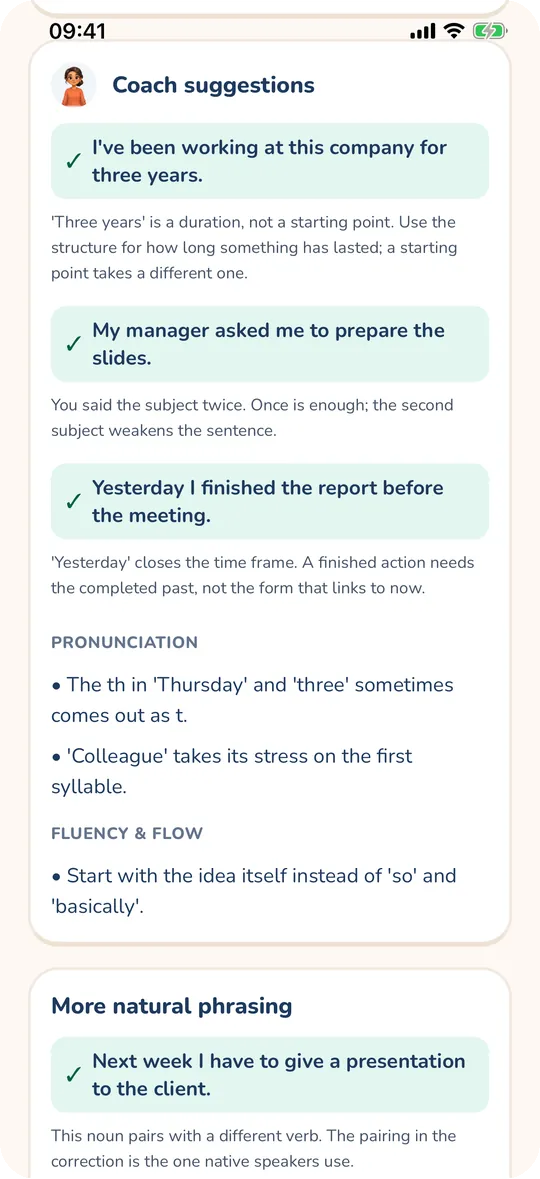
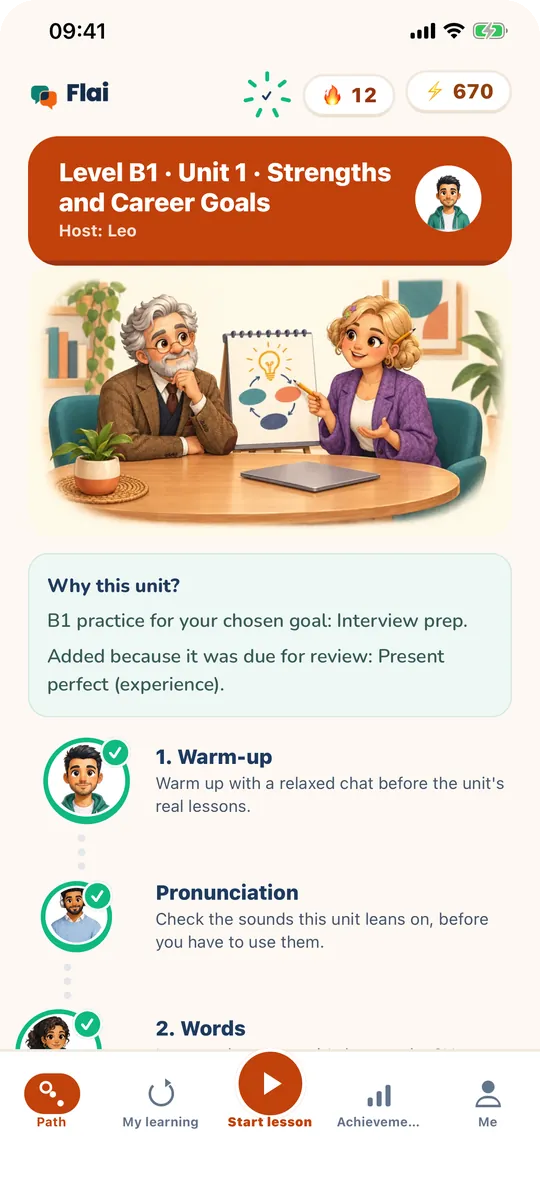
After practising, Flai offers live voice lessons with an AI coach, an analysed report after every lesson, a personal learning path, Italian pronunciation drills and review exercises. The app has no CILS, CELI or PLIDA module.
FAQ
Can I prepare for the oral from the US or the UK?
This rehearsal runs online from anywhere. For the real exam, the CILS B1 Cittadinanza syllabus says it is aimed at adults living in Italy or abroad. Look up the nearest exam centre and its dates on your certificate's own website.
I have not chosen between CILS, CELI and PLIDA yet. Can I still practise?
Yes. When you open the rehearsal you pick your certificate, or say you are not sure yet, and the situations in the questions change. Study each exam's official format with its own materials.
What do I see after recording?
Once you enter your email, the full report opens on screen right away. Continuing with Pro in the app is paid.
Sources
Checked on 4 October 2026: Law 91/1992, art. 9.1, citizenship on the Ministry of Foreign Affairs site, CILS B1 Cittadinanza syllabus, CELI 2 i (B1) Cittadinanza exam description and PLIDA exams.
Sources
- Normattiva: Legge 5 febbraio 1992, n. 91, art. 9.1
- Ministero degli Affari Esteri: Cittadinanza
- CILS: Sillabo B1 Cittadinanza
- CVCL: CELI 2 i (B1) Cittadinanza, descrizione dell'esame
- Società Dante Alighieri: Esami PLIDA
Checked on October 4, 2026. Exam rules change; always confirm with the official source.